
Rules
The Vitesse Racing League rulebook. Last updated .
Welcome to the Vitesse Racing League rulebook. These rules apply to every tier and every session: qualifying, the race, and everything in between.
Our aim is simple: close, clean and fair racing that everyone enjoys. The rules are there to keep it that way, not to catch people out. If something isn't covered here, the stewards will decide, based on the spirit of these rules.
Before you race, please read the whole rulebook, especially On Track Behaviour, Overtaking and Defending and Qualifying. "I didn't know" won't count as a defence.
If something happens on track, open a report ticket on Discord and add clear video evidence. Stewards look at every report, and their decisions refer to rule numbers (like 2.4), so you can see exactly which rule was used. To challenge a penalty, see Appeals. For how penalty points and bans add up, see Penalties.
The rules may be updated during the season. The date at the top of this page shows when they last changed.
Section 1: On Track Behaviour
- Drivers are expected to race clean to the best of their ability. Races are 50% distance, so there's plenty of time to overtake. Unnecessary or risky moves will be penalised.
- Retaliation of any kind (deliberately hitting, blocking or pushing off another driver after an incident) is penalised with 12 penalty points, which means an automatic race ban (see Penalties). Very serious cases can get more.
Collisions
- Causing a collision will be penalised, whether or not you were overtaking. The stewards decide the penalty based on how serious it was and how much it cost the other driver (see rule 7.5).
Rejoining the track
- If you go off track, rejoin safely. Don't cut back across the racing line in front of other cars. Wait for a gap, even if it costs you time.
Brake testing
- Brake testing is not allowed. That means braking suddenly or much earlier than normal, on purpose, to unsettle or catch out the car behind.
Sprint races
- Sprint races are shorter, but the same standards of clean racing apply. A shorter race is no excuse for a risky move.
Section 2: Overtaking and Defending
Defending
- When defending, you may change your line once on a straight. In a braking zone or corner, don't change your line to defend.
- Changing line more than once to block another driver is blocking, and the defending driver will get a penalty.
Divebombing
- Avoid divebombing from one car length or more behind. If you do, it's only legal if it's clean: there's no contact, and the defending driver didn't have to steer away to avoid a collision.
- The defending driver may close the door on a divebomb from one car length or more behind at any point. If there's contact, it's the attacking driver's fault, because the divebomb was dangerous.
The pictures below show what these rules mean.
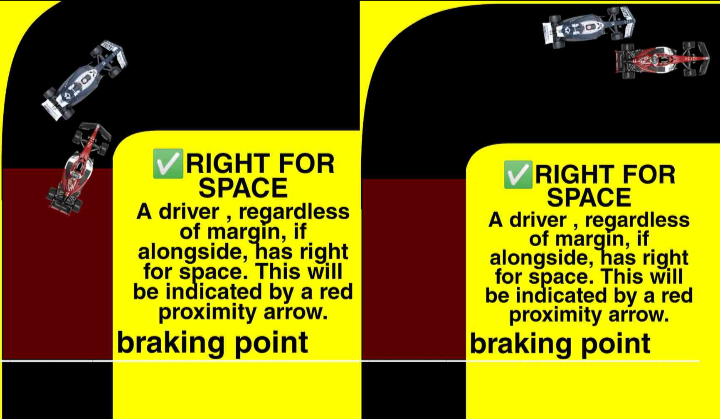
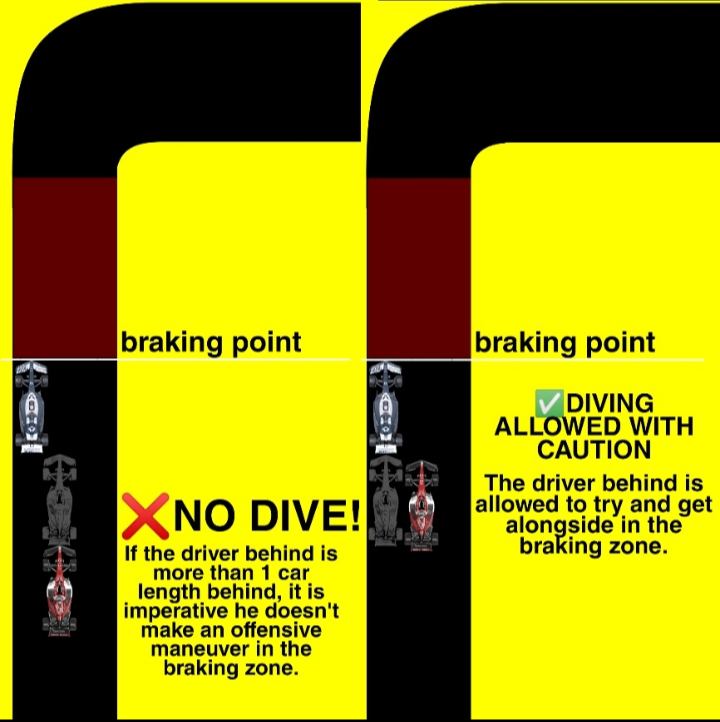
Side by side through a corner or on a straight
The picture below shows side-by-side racing.
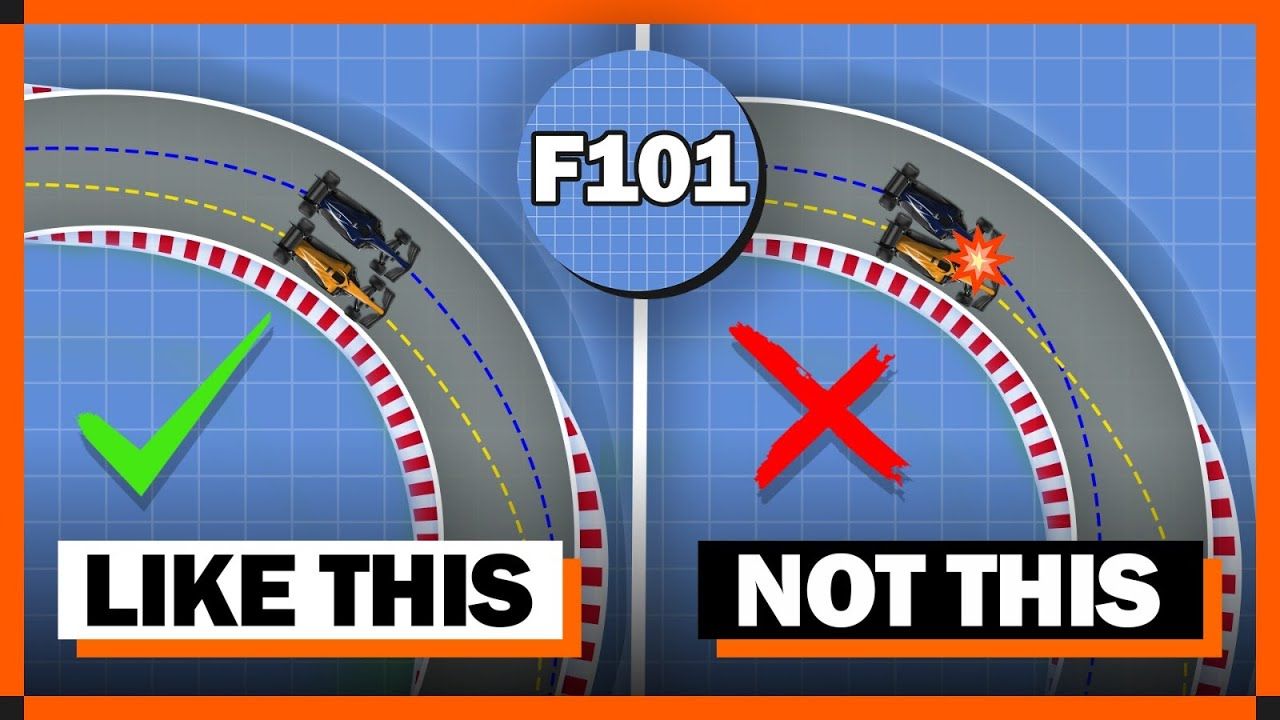
Pushing someone wide
This league does not use the "ahead at the apex" rule. Being ahead at the apex never gives you the right to push another driver off the track.
- Pushing another driver wide is penalised whether you're ahead or behind at the apex, and even if you end up behind them.
- If the defending driver pushes the attacking driver wide, and the attacking driver gets past while off the track because of that push, they don't have to give the position back.
Giving positions back
- If you gain a position by breaking any rule in this rulebook, give the position back straight away.
Section 3: Qualifying
Right of way
- During qualifying, a driver on a valid hot lap always has right of way. Any driver who isn't on a timed lap must get out of their way, whatever their track position, time, the weather or the flags.
- If you're not on a hot lap, stay off the racing line.
- If your lap has already been invalidated, you may use the racing line, but you must still move aside for anyone coming up behind on a valid hot lap.
- Drivers on a valid hot lap never have to give way, even if they're slower than the car behind. When two drivers on hot laps meet, both may stay on the racing line or fight to get back onto it, but they must not make contact or cost each other a lot of time.
Contact
- Causing contact in qualifying will be penalised. That includes contact that could have cost the other driver time or damaged their car.
- Racing other drivers in qualifying and causing an incident will also be penalised.
Penalties
- First offence, if the driver made a real attempt to get out of the way: a warning.
- First offence with no real attempt to move, or any repeat offence: penalty points or a qualifying ban, depending on how serious it is.
Moving out of the way late is better than not moving at all. Stewards will always be stricter on drivers who make no attempt to move.
Sprint weekends
- Every rule in this section applies to sprint qualifying too.
Section 4: Illegal Overtakes
Yellow flags
- Overtaking under yellow flags is not allowed. Stewards will review each case individually.
- Each illegal overtake under yellow flags gets a 5 to 10 second penalty.
Safety Car and Virtual Safety Car
- Overtaking during a Safety Car or Virtual Safety Car, or during the restart after either, gets a 10 second penalty for each overtake.
Overtaking off track
- You must be within track limits when you complete an overtake, unless the driver you're overtaking forced you off.
- An overtake completed off track is an illegal overtake, and you must give the position back (rule 2.7).
Causing a collision
- If an illegal overtake causes a collision, the penalty is 10 seconds plus 2 to 7 penalty points, depending on how serious the crash is.
Section 5: Appeals
How to contest a penalty
- Some penalties given during a race can be challenged, and the stewards may remove them.
- To contest a penalty, you must add clear video evidence to your report ticket. It can come from your own car, another driver's car or the live stream.
- A penalty will only be removed if the stewards decide you were not at fault.
- Penalties the game gives you for an incident you caused will not be removed.
Track limits
- To have a track limits penalty or warning removed, you must also show proof, usually from the race director, that the warning wasn't your fault.
- Track limits penalties and warnings are only removed if you were forced off by something outside your control, such as a collision or a brake check.
- Running wide or overshooting a corner on your own won't get a warning or penalty removed.
Unfair time penalties from the game
- If the game unfairly gives you a time penalty, how much is taken off depends on whether you served it in the pit lane:
| Penalty | Not served in the pits | Served in the pits |
|---|---|---|
| 5 seconds | All 5 seconds removed | 3 seconds removed |
| 10 seconds | All 10 seconds removed | 5 seconds removed |
| Drive-through | (not possible) | 10 seconds removed |
Time served in the pits can't be given back in full, because you lose less time in the pit lane than the penalty itself. Exception: a drive-through caused by a VSC turning straight into a Safety Car can have up to 20 seconds removed (rule 11.5).
Final decisions
- Once the stewards have decided on an appeal, their decision is final. The same incident won't be looked at again unless new evidence comes to light.
Section 6: Qualifying Bans
During a qualifying ban
- A driver with a qualifying ban may still go out on track for an out-lap, to check their setup and get some practice, as long as they don't set a lap time.
- After the out-lap, the driver must return to the pit lane.
- If a driver with a qualifying ban starts a timed lap by mistake, they must invalidate it and go straight back to the pits.
Breaking a qualifying ban
- First time: the driver also gets a qualifying ban for the next race.
- Every time after that: the driver gets a qualifying ban for the next race, 3 penalty points and a 5 second penalty in that event's race.
Sprint weekends
- On a sprint weekend, a qualifying ban is served in qualifying for the main race, not in sprint qualifying. The driver can take part in sprint qualifying as normal. Any 5 second penalty from rule 6.5 is also added to the main race.
Section 7: Penalties
Types of penalty
- When the stewards review an incident, they can give five types of penalty:
- Warnings
- Time penalties
- Penalty points
- Qualifying bans
- Race bans
What builds up to what
| You collect | You get |
|---|---|
| 3 warnings | A penalty |
| 4 penalty points | A qualifying ban |
| 12 penalty points | A race ban |
- A qualifying ban given directly by the stewards does not add 4 penalty points.
- A driver who gets several 10 second penalties from the stewards may also be given a penalty point.
Time penalties and not finishing
- If the stewards give you a time penalty and you don't finish the race, the penalty carries over to the next race.
Stewards' discretion
- Where a rule doesn't say what the penalty is, the stewards choose one of the penalties above, based on how serious the incident was and whether the driver has done it before.
Penalty points reset
- Penalty points reset to zero at the start of each new season.
Sprint weekends
- A race ban on a sprint weekend covers the whole weekend: sprint qualifying, the sprint, qualifying and the main race.
- If you get a time penalty in the sprint and don't finish it, the penalty is added to your main race result that weekend.
- A qualifying ban on a sprint weekend is served in qualifying for the main race (see Qualifying Bans).
Section 8: Pitlane Rules
Entering the pit lane
- Keep a reasonable speed on the pit entry. Don't deliberately drive well below the pit limiter speed.
- Brake for the pit limiter line at a sensible distance from it, not far too early.
- You may slow down to leave a bigger gap and avoid double stacking with your teammate, but only if no cars are coming into the pit lane behind you.
- Don't cross the white line that separates the pit entry from the track.
Exiting the pit lane
- Don't cross the white line when leaving the pit lane, in any session.
- Even if you've only just left the pits, you must leave space for cars already on track.
- In qualifying, if crossing the pit exit line makes you get in someone's way, you'll get the same penalty as for impeding (rules 3.7 and 3.8).
Penalties
- Breaking the pit entry rules: a warning for the first offence, then 1 penalty point for the next, with more penalty points for each one after that.
- Breaking the pit exit rules will be penalised.
Section 9: Disconnections and AI
Who is responsible
- While the AI is driving your car, it counts as you. Anything it does is treated as if you did it.
- The only exception is after you've finished qualifying: if the game puts the AI in your car for the rest of the session and you can't take control, you're not responsible for what it does.
- If your AI causes an incident, you get the same penalty you'd get if you had caused it yourself.
Disconnects
- A driver who spends a long time in AI mode during a race, whether from a disconnect or any other reason, will be disqualified, unless they can prove they weren't racing as the AI.
Safety Car and Virtual Safety Car
- Letting the AI drive your car under a Safety Car or Virtual Safety Car is not allowed, as it counts as dangerous driving. Penalties:
- First time: a warning
- Second time: a time penalty
- Third time and after: 1 penalty point plus a 5 second penalty
Section 10: Retiring on Track and Resetting to Track
Retiring
- Never retire your car on track during a competitive session. A stopped car can cause incidents.
- If you need to retire, drive the car into the pits and retire there.
- Retiring on track gets 1 penalty point.
Resetting to track
- Don't use reset to track after going off. It can gain you time and cause incidents.
- Resetting to track gets a 5 to 10 second penalty.
Section 11: Safety Cars
Overtaking under a Safety Car or Virtual Safety Car is covered in rule 4.3.
Safety Car restarts
- If the game slows down the leader, or a car near the front, for going too fast at a restart, the driver who restarted too early gets the penalty. Usually that's the leader.
Virtual Safety Car
- When the VSC comes out, don't slam on the brakes straight away, even if you're under the delta time. If there's a car behind you, slow down gradually: by the next corner, or over 5 to 10 seconds.
- Braking suddenly with a car close behind will be penalised.
VSC turning into a Safety Car
- If the VSC turns into a full Safety Car straight away and the game gives you a drive-through because you didn't have time to slow down, you can appeal (see Appeals).
- If the stewards agree there clearly wasn't enough time, the full 20 seconds can be removed, instead of the usual 10.
Nothing in the rules matches that search.